Vonnie’s Observations
Since I haven’t written for days, and I have so much to write, I thought I would break it up into little vignettes so that you could read one a day or something so you wouldn’t get bored:
Tweezers: Daddy says I should tell you about an incident that occurred as we were trying to board Royal Jordanian at Heathrow Airport in London. As we were approaching security, there was a preliminary checkpoint manned by two young Jordanian men. I asked for a zip-lock bag for a couple of tiny bottles of lotion that I had forgotten in my cosmetic bag. As I was fishing for the lotion, the young man grabbed my bag and looked through it. He pulled out my tweezers and with one swift motion, dropped them through a trap door at the end of his counter. I shrieked, “What have you done? Those are the best tweezers I ever had!! Take them out!!” He was so startled that he pulled them out and showed me how dreadfully sharp those tweezers were, slicing them across his neck to indicate that I could definitely decapitate someone with them. I snorted in derision, and he grinned kind of sheepishly, but dropped them back into his trap door insisting, “Very sharp, very sharp.” I screamed “Nooooooo!!!” and covered my face with my hands in horror and grief. He stared at me in bewilderment and confusion and opened his trap door and showed me the huge collection of scissors and nail clippers in his bin saying, “See, many in there.” “Take them out. Take them out,” I begged. “Those are the best tweezers I ever had!” So he fished them out again but only to explain to me that if he gave them back, I would only be arrested when I went through security with such a weapon. He was confiscating them for my own good. “Let me try,” I begged. “Please let me just try.” But he dropped them into his bin again and dismissed me with a firm, “I’m sorry. Not allowed!” But he hadn’t reckoned on the determination of a Scottish woman deprived of the most expensive tweezers she had ever bought! I marched over to the older man at the next checkpoint. He was dressed in a very impressive uniform and was enthroned on a platform that lifted him above the riff-raff he supervised. I pointed back at the young whippersnapper and cried, “He took my tweezers!” “What!” roared the big man, “Tweezers are allowed!” “Tweezers are allowed??” I repeated. “Yes, tweezers are allowed!” “Oh, thank you, thank you!” And back I went to the young man to report. So he opened his trap door, fished them out for the third time but told me that I must show the supervisor how dreadfully sharp these particular tweezers were. I promised I would, and I did, and he pronounced, “Allowed!” And that’s how I still have my tweezers.
Madaba: On Friday, June 27, our driver took us to Madaba, a village south of Amman.
The Bible talks about the plains of Madaba, and sure enough, the terrain opened up into fields of vegetables and grain and grazing goats and sheep. (I have been fascinated by the Bedouins—here pronounced Bed-ween’-- who pitch their tents throughout the city of Amman, herding their goats and camels along the sides of the freeways and streets. So picturesque. Here on the plains of Madaba, they were everywhere.) This was the area where the Moabites lived in the Bible – where Ruth left her family to follow Naomi back to Israel. We went to an ancient church where archeologists had recently uncovered a mosaic floor that had been plastered over. The mosaic told the story of Jesus’ baptism, and it had a map to the exact site on the Jordan River – so the traditional site has now been changed. The people of Madaba specialize in mosaic art even now, and we went to visit a government subsidized “factory” where handicapped women are employed to make beautiful mosaic art to sell to tourists. We couldn’t afford it, and anyway it would have been difficult to take home, but we were fascinated to watch the women at work, chipping stone into the tiniest pieces and gluing it in place temporarily with flour and water paste. When they had it perfect, they would use permanent cement.
As we drove through the village of Madaba, I was dazzled with the streets of the bazaar, thronged with people in native dress, shopping. I asked to stay there while Daddy and our driver went to the museum. Once again, I loved connecting with the women in their black robes and scarves (not burkas). I took lots of pictures of shoppers and shops (some with live chickens for sale, some with dead goats hanging by their heels, some with burlap bags of lentils and grain.) It was Friday, so at certain times, the loudspeakers on the tops of the mosques would broadcast the service complete with passionate sermons. I could catch a few words like “Ibrahim” and “Mujahidin”. The shoppers didn’t seem to be listening.
Mt. Nebo and the Baptismal site: From Madaba, we drove up, up, up to Mt. Nebo, where Moses was given a view of the promised land before he died and was buried by the angels. Of course, we believe God raised him and took him to heaven. As we neared the top of the mountain, I gasped as the land suddenly feel away from the side of the road, and I could see a terrifyingly barren wilderness. It was so hot, even on top of Mt. Nebo, that I could imagine how desperately the Israelites would need the shelter of God’s cloudy pillar. I was surprised that so many of the famous Bible sites (like this) are in Jordan rather than Israel, and the Muslim people revere them just as much as we Christians do. I struggled to grasp that I was standing right where Moses stood. The day was a bit hazy, but our driver said that on a clear day, a person could see all the way to the Mediterranean Sea at the farthest coast of Israel.
From Mt. Nebo, we drove down, down, down into the Jordan River Valley. Our driver had to stop at a checkpoint where soldiers asked to see our passports. Our driver explained that this area was so close to the Israeli border (the Jordan River is the border) that it was heavily guarded on both sides. We stopped at a little visitors’ center and waited in a souvenier shop for a “bus” to take us closer to the river. Our group consisted of a Polish couple with a little girl and two Russian young people traveling together through the middle east. The girl spoke excellent English and told us that they had only two dinar left and were hitchhiking back to Amman where they had a youth hostel reservation. After more checkpoints and soldiers, we stopped at a rock-lined trail bordered with olive trees on both sides. Our guide hurried us along the trail for half a mile or more until we arrived at a green stream about twenty feel wide. This was the traditional site of Jesus’ baptism for many years. We could look across to the West Bank of the Jordan, which, since 1967, has been Israel. After a few minutes, our guide hurried us on down the path to the corrected site. Suddenly a soldier appeared and escorted us to the site. We could look across and see guard towers on the Israeli side and a huge building the Israelis were building as a visitors’center. There was a huge stone baptismal font where we dipped our hands and anointed our faces with the cool water. Daddy went down to the river and dipped his feet in the water. Our young Russians jumped in and went swimming, and the soldier watched them like a hawk. After a few minutes, he said something to our guide who abruptly told us our time was up and we had to leave. I struggled to escape the current reality and travel back in time in my imagination so that I could immerse myself in the spiritual richness of being in the very spot where the dove landed on Jesus’ shoulder and the Voice from heaven affirmed Him as God’s beloved Son. It was difficult, but Daddy helped me by reminding me that when Jesus was baptized, there were Roman soldiers and ethnic stresses, too. We fished our Russian friends out of the Jordan, our guide relaxed, and we headed back to the bus. We asked Mustafa if we could give the Russians a ride back to Amman, and he agreed. We took them to a horribly rundown building in the old part of the city—a fascinating part. Mustafa stopped the car, and insisted that we try a Jordanian dessert – warm goat cheese with sugar and spices on top. Yummy! I think I wrote about that before.
Sabbath in Amman: Daddy was so passionately determined that we must go to church. I asked God to help me understand why it was so important to him, and I remembered that he had preached a sermon at the “shock and awe” beginning of the War on Iraq that tried to imagine what the pastor of the Baghdad Adventist Church would preach on the last Sabbath before the War. I suddenly realized that Daddy was hoping to find those Iraqi Adventist brothers and sisters who had suffered the terror of the US bombing. I think he has written about his very emotional meeting with the very pastor who preached that last sermon. Amazing! He is now the pastor of the little church in Amman where we attended. The service was very inspiring, given in English by a visiting Conference minister, and translated into Arabic by this young pastor. We were invited to a potluck at the “Care Home” that the church runs for needy women. Such delicious food! And I was able to visit with a wonderful Circasian woman (a Muslim) who was visiting the church with her Adventist stepdaughter who teaches in New York City but was visiting her Jordanian step-family for the first time. Her Jordanian father (husband of the Circasian woman) had died a year before when he was cleaning his rifle and it went off and killed him. Daddy has posted a photo of me visiting with the woman. She was in such grief over the loss of her husband who was like an angel in her eyes. They had been married for 15 years, and their two boys were with her, ten and twelve. She had such a beautiful spirit, was very well educated, and we talked and talked about religion and politics and families and roles, and we found ourselves true soul mates. Her step daughter was lovely, too. She had never seen her father since her parents divorced when she was about seven. Her father had begged for her to come, but her Puerto Rican mother had been afraid to let her go to Jordan – understandably. It seemed very tragic, but I could see true love and respect between step-mother and daughter that was bringing healing. I will never forget my visit.
In the afternoon, we went to the Citadel, an amazing hill in Amman where an entire city from Roman times and before has been unearthed by archaeologistgs. The Jordanian Museum of Antiquities is located there. It is so unassuming, quite simple and very run down, but filled with treasures like the Dead Sea Scrolls!!!!
After we wandered for hours, we walked to the entrance and were pleased to find a taxi and a driver who had his little four-year-old son with him. He agreed to take us to our hotel. The concierge at the hotel had told us not to let taxi drivers charge us any more than three dinars for a trip around the city. We had to argue with every one. This man offered too take us here and there for extra sightseeing, but we just wanted to go home. At our hotel, he asked for twenty dinars (about $30 US) We expressed our shock, but he said he had been sitting at the gate of the Citadel for an hour waiting for us, and so we needed to reimburse him for that time. Daddy convinced him that we hadn’t asked him to wait there for an hour, so he said, “But I have my baby. Please give me extra money for the sake of the baby.” So we gave him eight dinars, and he very grudgingly accepted it.
Petra: On Sunday morning, we checked out of our fabulous hotel in Amman, almost in tears thinking that we wouldn’t ever see these delightful people again. Mustafa had sent his nephew to drive us to Petra. He was a wonderful young man who is looking for a special wife. (He hopes to marry Zorah, and I promised to find out whether she is married or not.)
Along the way, he asked if we would like to visit a Bedouin man that he knew. We assured him we would. He took us to a cave high on a mountainside. The inside was beautifully furnished with gorgeous rugs hanging around the walls and on the floor, and beautiful brocade sofas lining the walls. A young boy made tea for us and invited us in. He brought an ancient wooden case from somewhere, and opened it to reveal an astonishing collection of antiquities that his Uncles had found in and around a nearby castle built by the Crusaders. We gasped at Roman coins and seals, Byzantine clay lamps and bronze knives – like things that we had seen at the museum the day before!! Suddenly his Uncle appeared, a fascinating man who was willing to sell these antiquities. Daddy was worried because he thought they belonged in a museum, but eventually he chose a few of his favorite pieces and purchased them. It was a scene from a movie or a dream. We could hardly believe we were really experiencing something so exotic. The Bedouin welcomed us so warmly. Such hospitality!
We arrived in Wadi Musa about two o’clock, unloaded luggage at our hotel and our driver took us down the hill to Petra. We bought tickets and started walking downhill toward the Siq, a crevasse that cuts through the brilliantly-colored sandstone mountains of the area. A people called the Nabataeans used the Siq as an entrance to a secret city they had carved out of the mountains on the other side. The Romans had discovered it and used it, and then it was used by subsequent populations. (Daddy has probably told you the history.) As we walked along, I was in awe – not so much by the sandstone carvings, although they were astonishing, but by the Bedouins. There were hundreds of young men with camels, donkeys, horses and fabulously decorated carriages offering transportation through the Siq and beyond. Such exotic sights!! Daddy has sent photos – only a few of zillions we took, and we could have taken zillions more. It’s a magical world. I kept trying to put into words my awe at God’s artistry. He used such color, texture and lighting to create scenes of breathtaking beauty wherever we looked. We walked for hours until we found an archaeological site manned by a team from Brown University. We were so fortunate to meet an older couple who had been heading up the dig since 1968. They said that nothing had been unearthed when they started, and the Bedouin were living in the many, many caves on the hillsides. There were no hotels or restaurants, only a few stone huts in Wadi Musa. They offered us a ride in their jeep, and we accepted only because I was getting a blister. Their offer disappointed several young Bedouin men who had been negotiating with us for transportation by donkey.
The next morning, we filled our water bottles at Moses’ Spring, across the street from our hotel. Many native people came to get water while we were there. This is known as the spring that came from the rock Moses struck with his rod at God’s command. Daddy has sent a photo of the rock. With our water (and wearing tennis shoes instead of sandles this time) we headed into the Siq again. This time, we were hoping to reach a fabulous carved building called The Monastery that required climbing 850 steps carved into the mountain. It was 8 kilometers from the gate. As I walked, all the Bedouin boys we had met the day before pressed us to ride their donkeys. They would take us all the way to the Monastery, even up the stone steps, for only 50 dinars apiece!!!!!! You can imagine my Scottish reaction!! I kept telling them I needed to walk because I was too fat. They kept using logic worthy of Teo to argue with me in the most charming way—insisting that I could never make it. They plead with Daddy to hire a donkey for me because he might make it but his wife could not possibly get more than halfway up. I told them all that I wanted to walk as far as I could, but maybe later I would be too tired to walk back, and then I would talk with them about a ride.
After an hour or two of walking, we reached the bottom of the 850 stairs. We made the awesome climb, and around every bend, there was another breathtaking view – including one area toward the top where we could easily have fallen into a horrifying crevasse with a drop of thousands of feet. (You must see Daddy’s photos.) We reached the Monastery at about 6 PM, as the sun was slanting its lovely low rays across the face of the rock. The shadows made the details of the ancient carving so beautifully clear. We were relaxing on sofas (yes!!) outside a Bedouin cave where one could purchase cold sodas. We were almost the only ones there. Daddy, crazy as he is, asked the young Bedouin man who lived there, whether it was possible to climb to the top of the Monastery itself!! I begged him not to be so foolhardy and presumptuous. He paid no attention to my wisdom, and the Bedouin was only too happy to guide him up the side of the mountain and onto the pinnacle of the Monastery itself! I kept the camera on him, and got some fabulous shots of his grand achievement. When they got down, the Bedouin man asked if we had been to the viewpoint. He guided us to another place where one could sit on the very edge of a ridge and see the entire Great Rift Valley below, Israel another way, and on the top of a nearby peak, a little house or shrine marking Haroun’s Tomb (Aaron’s Tomb.) Awesome!
Since the sun was nearly setting by now, we thought we should get started down the mountain so that we wouldn’t fall into the crevasse in the dark. About two-thirds of the way down, we met Mohammed, one of the Bedouin boys who had negotiated with us. He was so relieved and amazed to see that I had made it that far! “Hello, my friend!” he called, and pressed a lovely colored rock into my hand. “For you!” “Mohammed!” I said, “I can’t believe you waited for me!” “I told you I would carry you back to the gate,” he said. “Many people are waiting for you.” “They are?” I exclaimed in amazement. Another boy came close to me and whispered, “When you told many to wait for you, you make problem!!” As we came around a bend, I saw Mohammed’s donkey waiting, and then about six other boys and their donkeys appeared. They all began shouting and trying to convince me that their donkey was the first one I had promised to ride. The rest of the way down the stairs, we were trying to keep out of the way of boys and donkeys who were arguing with each other over whose donkey was best able to carry this fragile old lady. Fauzal and his supporters told me that if I rode Mohammed’s donkey, I would definitely fall off and break some part of myself like an Australian lady who had fallen off earlier in the day. Mohammed and his supporters shot back that if I fell off, all I would have to do was call the police. They were so adorable in their earnestness and businesslike logic that I couldn’t help laughing in delight. Daddy, though, was worried and took it more seriously. The rest of the way down, emissaries of one or the other of the boys would come alongside me and urge “Ride with Fauza. He is good man and has good donkey. You will have good ride.” Or “Ride with Mohammed. Fauzal is crazy boy. Very bad boy. You don’t want ride with him.” By the time we got to the bottom of the stairs, I did realize how serious it was, and I was sorry I had unwittingly “made problem.”
We tried to solve it by saying we wouldn’t ride anyone’s donkey. We would walk, but we would give each of them 5 dinars. They were shocked and insulted. “We don’t take money for no work.” Okay, then, Ole would ride Fauzal’s donkey and I would ride Mohammed’s, and they would each get ten dinars. Fauzal accepted the money, and he tried to give Mohammed 10 dinars, but with great dignity Mohammed explained that he did not believe in “Breaking Business”, and since I had chosen Fauzal, I would have to ride his donkeys along with my husband. Gravely he said “Nice to meet you”, bowed and turned away. I felt very sad that I had disappointed anyone, and I wasn’t in the mood to ride, so I strode off through the darkness with Daddy’s walking stick to steady me, and he rode with Fauzal on the two donkeys. Behind me, I heard Fauzal talking with Daddy about why I wouldn’t ride. “You know why she won’t ride?” Daddy asked him, thinking to explain my sadness and frustration at the dispute. “Because she doesn’t listen!” Fauzal answered with conviction. “Well, that, too,” Daddy agreed. I couldn’t help bursting out laughing. We said “Goodbye” to Fauzal at the entrance to the Siq. We walked through by the light of luminaries (candles placed in paper sacks weighted with sand.) It was awesome to look up at the sky showing between the stone walls and see brilliant stars outlining the Big Dipper! By the time we got back through the Siq and up the hill to the gate, we were exhausted. The gate attendant told us we had walked 16 kilometers – mostly uphill.
We are now in Aqaba, reading your mail, paying bills, doing laundry and catching up on our writing. We are ready now to head off to the Red Sea for snorkeling. We love you!
Mama

 Tomorrow, Wednesday, we continue our exploration of northern
 Israel. However, before we pack up and move on from the Eden Hotel in Tiberias beside Lake Kinneret (Sea of Galilee), Vonnie and I want to
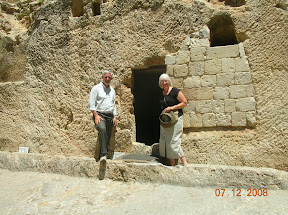
 share a few photos. (one photo is from our window overlooking Tiberias and the lake.)
 enjoyed our Sabbath morning at Advent House, Jerusalem, where I was invited to preach. We visited the Shrine of the Book,
 dedicated to the Dead Sea Scrolls, that afternoon. And the next morning, we packed our little car with luggage for three and two additional people!


 Bethsaida, of the city of Andrew and Peter.” We truly enjoyed our time, alone on the dig-site with time to meditate and pray. (Several photos are from here.)
 another site, now in private ownership, is much closer to the lake shore and much more likely to have been the real place. So the arguments go! It was a very special stop. (this is the last photo.)



 Posts
Posts

